Foundational statements
0. Life internalises the means of internalising — it builds, repairs, and reproduces the machinery that does the internalising.
0. Covolution predicts that retained biological information is not produced by selection alone. Some fraction comes from constrained generation: the prior structure of developmental systems, genotype-phenotype maps, mutation architecture, regulatory circuits, and symvironmental feedback that make certain variants more likely to appear, stabilize, and be inherited before selection acts. The relative fraction is an empirical quantity, not a doctrine.
1. Generative architecture and structured arrival
Generative architecture structures what can arrive. Sorting describes what subsequently persists, proliferates, or becomes represented. Selection is one causal process that can contribute to that sorting.
Covolution explains why some forms, variations, and trajectories are more likely to be generated, accessible, and stabilized than others, and how these generative biases are themselves recursively modified through evolutionary history.
2. Organisms structure evolutionary possibility space
Organisms and their molecular, developmental, regulatory, behavioural, and symvironmental architectures structure the state space in which variation is generated and explored.
Variation is therefore not sampled uniformly from all physically imaginable possibilities. Genotype–phenotype mappings, developmental constraints, regulatory networks, mutation architectures, physical landscapes, and behavioural feedback create highly non-uniform accessibility distributions.
3. Physical directional structure precedes focal selection
Physical energy landscapes can generate strongly directional structural outcomes independently of the focal episode of biological selection.
Protein folding funnels are an example: given a sequence and physical conditions, the energy landscape strongly biases the accessible conformational trajectories and stable outcomes. This does not abolish natural selection and does not itself constitute adaptation.
4. Natural selection remains central to adaptation
Natural selection is the best-established mechanism for the cumulative evolution of adaptive fit, but the variants on which it acts are produced within a highly structured generative system.

The first is shaped by generative architecture. The second may arise through natural selection, drift, hitchhiking, developmental filtering, cross-level effects, demographic processes, and other causes.
5. Structured arrival

6. Informational architecture prior
An informational architecture prior exists when the probability distribution over accessible outputs is systematically biased by properties of an information-processing architecture, such that formal properties of possible outputs—such as compressibility, modularity, degeneracy, symmetry, or description length—predict their accessibility or frequency beyond what can be explained by immediate fitness differences alone.

and some structural property (C(v)) predicts this distribution:

7. Evolutionary decomposition
In Covolution theory, evolutionary change is decomposed at minimum into a generative component and a sorting component, with the sorting component further decomposed into its causal mechanisms, including natural selection.


The generative-architecture component describes biases in the production, accessibility, and pre-sorting stabilization of variants. The sorting component describes differential representation, persistence, proliferation, or transmission of variants after they exist. Natural selection is one causal contribution to sorting.
8. Covolution as structured arrival plus recursive state-space construction
Covolution is a theory of structured arrival and recursive state-space construction, in which natural selection is retained as one causal process within a larger information-processing and state-transforming loop.
9. Selection is internalized, but not universalized carelessly
In Covolution theory, natural selection is neither denied nor treated as the universal source of evolutionary order. It is internalized within a larger information-processing architecture.
At the biological level, natural selection is a specific causal process in which heritable differences contribute systematically to differential reproductive or persistence outcomes.
At more general physical or informational levels, Covolution refers more cautiously to selection-like filtering, stabilization, or state-dependent persistence, rather than assuming that biological natural selection operates everywhere.
The deeper prerequisite is distinguishability. Perturbations, asymmetries, gradients, boundaries, and constraints create distinguishable states. Differences can become signals when they alter state transitions, become information when they can be stored or reliably read, and become evolutionary material when they participate in persistent generative and feedback processes.
Biological natural selection is therefore not the origin of distinguishability or generativity. It is a specialized biological mechanism acting within a much older and more general dynamics of state generation, constraint, stabilization, transformation, and recursive feedback.
The distinction is:

10. Sorting, selection, generative architecture, and Covolution
Sorting is the observable pattern of differential persistence, proliferation, representation, or transmission among variants. Selection is one causal mechanism capable of producing sorting. Generative architecture structures the production, accessibility, and stabilization of the variants that enter sorting. Covolution is the recursive coupled dynamics through which generative architectures, sorting processes and their causes, horons, and the Symvironment continually reconstruct one another and thereby reshape the space of future evolutionary possibilities.
Distinguishability => State space => Generative architecture => Structural variation => Sorting => Persistence/Transmission
The resulting Covolution architecture

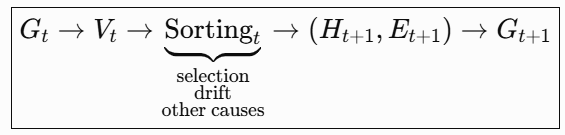
is generative architecture, the structured set of accessible variants, the relevant horon state, and the Symvironment.
Darwinian selection primarily explains differential success among variants. Covolution additionally asks why those particular variants existed, why some were easier to reach than others, how the space of possibilities was constructed, and how the consequences of sorting recursively alter the architecture that generates future possibilities.
Covolution is the recursive evolution of evolutionary possibility itself. Generative architecture structures what can arise; sorting records what differentially persists; selection is one cause of sorting; and horons and their Symvironment continually reconstruct the architecture that determines what can arise next.
댓글 0