Symvironment
Symvironment (n.) is a term coined by Jong Bhak within the covolution framework to name the integrated informational network within which a horon exists, processes, and acts. It refers to the totality of internal and external informational structures with which a horon is computationally coupled — including other horons, supporting substrates, environmental conditions, cultural and technological surroundings, and the horon's own internal regulatory architecture — considered as a single co-determining system.
The term is composed from sym- (together, with, jointly) and environment. It signals that the entity and its surroundings are not separate things passively interacting, but a coupled system whose components actively co-construct each other. The framework uses symvironment rather than environment to mark this departure: where environment implies a stage on which an organism acts, symvironment implies an integrated computational network of which the organism is a constitutive participant.
The original framing of the term invoked symbiosis + entanglement + environment as etymological components. Symbiosis is appropriate (it captures the mutual constitution). Environment is the base concept being extended. Entanglement, however, is used metaphorically rather than in the technical quantum-mechanical sense; the framework does not claim that the coupling between horon and symvironment is quantum entanglement. Entanglement here is shorthand for deep, mutual, computational coupling that cannot be cleanly separated into independent parts.
Symvironment, horon, internalized selection, entelenomy
There is another step beyond internalizing a fixed external selector.
Horons also change the selector itself.
Consider:
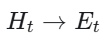
through niche construction, technology, communication, institutions, etc.
Then:

So organisms first model external selection and later modify it.
This gives two directions:
Internalization

The external world becomes partly represented inside.
Externalization

Internally generated information changes the external world.
Together:

This is why Symvironment is more fundamental than an ordinary environment.
The selection environment is no longer purely given.
It is partially computed by interacting horons.
For reputation, mate choice, rank, teaching, markets, sanctions, and institutions: internally generated evaluations become externally causal.
What symvironment names
The concept addresses a limitation in the standard organism-environment distinction. Classical biology has tended to treat organisms and environments as separable: the organism is the active entity, the environment is the passive setting in which the organism lives and to which it adapts. This framing has been productive for many purposes but understates several real features of biological and broader horonic existence.
Symvironment names what becomes visible once these features are taken seriously.
Organisms and surroundings actively co-construct each other. Beavers modify their hydrology; corals build their reefs; humans construct their cities; bacterial colonies remake their chemical environments. The surroundings are not given; they are partly produced by the horons that inhabit them. Symvironment captures this two-way construction.
Information flows in multiple directions simultaneously. A horon processes information about its surroundings, but its surroundings also process information about it (through other horons, through coupled feedback loops, through accumulated traces of its activity). The information is not transmitted in one direction from a passive environment to an active organism; it circulates through the whole network. Symvironment names this multi-directional flow.
Boundaries between internal and external are functional rather than absolute. A cell's interior is distinct from its exterior, but the membrane is permeable to information and material. An organism's body is distinct from its surroundings, but its sensory and metabolic activity continuously couples the two. An institution is distinct from its members but constituted by them. The boundaries are real but porous, and the horon's existence depends on continuous flow across them. Symvironment treats internal and external aspects as parts of one coupled system rather than as fundamentally separate domains.
Other horons are part of the symvironment. The horon does not exist alongside lifeless surroundings; it exists within a network that includes other horons (predators, prey, conspecifics, symbionts, competitors, cooperators, descendants, ancestors). These other horons are not merely environmental features; they are computational participants in the same network. Symvironment includes them as such.
The term is therefore broader than environment in the classical sense, narrower than universe or world, and structured around the specific concept of computational coupling that the covolution framework develops.
Symvironment and the horon
The relationship between symvironment and horon is constitutive on both sides.
A horon is constituted partly by its symvironment. The horon's distinguishability, its internal state-space, its computational capacities, and its predictive coupling all depend on the symvironment's structure. A horon stripped of its symvironment is not a horon-alone but a horon-in-dissolution; the symvironment is part of what makes horonic existence possible.
A symvironment is constituted partly by its horons. The network of computational couplings that constitutes the symvironment exists because horons participate in it. Without horons doing the processing, predicting, and acting, there would be patterns of physical interaction but no symvironment in the framework's sense.
This mutual constitution is what symvironment is meant to capture that environment does not. An environment can exist without an organism (the surface of Mars is an environment but supports no life); a symvironment is defined by the presence of the horons whose computational activity makes it a network of the relevant kind. Symvironment is therefore not a substrate-independent concept; it is the specifically horonic relational structure that arises wherever horons exist in coupled networks.
What flows through a symvironment
Several kinds of flow are characteristic of symvironments.
Information. Horons process information about other horons, about substrate conditions, about anticipated futures. This information flows through sensory channels, regulatory cascades, signaling networks, communication, and cultural transmission. The flow is multi-directional and continuous.
Material and energy. Horons exchange material and energy with their symvironment — taking in resources, exporting waste, building structures, dissipating heat. These flows are not separable from information flows; they carry information and are shaped by information processing.
Distinguishability. Switches accumulate in regions of intense horonic activity and disperse from regions where horonic activity has ceased. The symvironment is the medium through which switches flow, concentrate, and redistribute. (This connects to the framework's treatment of switching density and covolution as switch-concentrating activity.)
Constraint. The symvironment imposes constraints on horons — physical, chemical, biological, social, cultural. These constraints partly determine the horon's parafate (the constrained band of available trajectories). But horons also impose constraints on their symvironment, modifying it in ways that shape what subsequent horons can do.
Prediction and influence. A horon's predictions about its future state influence its current behavior, which modifies its symvironment, which feeds back to alter what futures are available. The temporal structure of the symvironment is not strict past-to-future causation but a more complex weave in which anticipated futures influence present configurations.
Core principles
Several principles characterize how symvironments operate.
Computational integration. A symvironment functions as a distributed information-processing system. The horons within it are not isolated processors but coupled computational participants. The system as a whole performs computations that no individual horon performs alone.
Mutual co-determination. Horon and symvironment shape each other through ongoing interaction. Neither is the active partner with the other as passive backdrop. Both are active; both are partially constituted by their coupling to the other.
Structured openness. A symvironment is structured enough to produce predictable patterns and open enough to permit genuine novelty. The structure is paradetermined — outcomes fall within constrained bands rather than being either fixed or random. Symvironments are therefore environments in which prediction is possible but not exhaustive.
Dissolved-but-functional boundaries. The classical organism-environment boundary is not abolished — horons really do have boundaries that distinguish inside from outside — but it is functional rather than absolute. The boundaries are sites of intense exchange rather than walls of separation. Symvironments are systems of permeable boundaries through which information, material, and constraint continuously flow.
What changes in a symvironment-based framework
Treating organisms as participants in symvironments rather than as adapters to environments changes several standard claims.
Selection becomes multi-directional. Classical Darwinism treats natural selection as a one-way pressure from environment to organism. In a symvironment framework, selection runs in multiple directions: the symvironment selects on horons, horons select on their symvironment (through modification, choice, and construction), horons select on each other (through interaction, cooperation, conflict), and horons select on their own future configurations through covolutionary activity. Selection remains a real evolutionary force, but it is one element in a multi-directional network rather than a unidirectional pressure.
Adaptation becomes mutual construction. Classical adaptation treats organisms as being shaped to fit pre-existing environments. In a symvironment framework, adaptation is mutual: organisms shape themselves to fit their symvironments, and they shape their symvironments to be fit-able. The fit between horon and symvironment is constructed from both sides, not fitted by one side to the other.
The boundary between biological and non-biological participants becomes permeable. A symvironment can include genes, cells, organisms, tools, machines, software, cultural practices, infrastructures, and AI systems as co-participants in the computational network. These participants differ in their substrates and capabilities, but they all contribute to the network's computational activity. The substrate typology of horons (biological, cognitive, social, technological) maps onto different kinds of participation in symvironments rather than dividing the world into ontologically separate domains.
Reciprocal causality becomes central. A horon's predicted future influences its present behavior, which modifies its symvironment, which alters the conditions for future prediction. The temporal structure is not linear causation from past to future but a recursive weave of past, present, and anticipated futures. This is characteristic of horonic existence in symvironments and connects to the framework's treatment of paradetermination and parafate.
Illustrative example
The classical Darwinian account of a fish in a river describes the fish as adapting to the river's temperature through random mutations selected by survival. The river is the environment; the fish is the organism; selection runs from environment to organism.
A symvironment-based account is structurally different. The fish is a horon engaged in continuous information processing — sensing temperature, computing thermal patterns, anticipating seasonal change, adjusting metabolism and behavior. The river system is itself a network of interacting horons and substrate conditions: water flow and chemistry, microbial communities, plant life, predators and prey, insect populations, seasonal cycles, accumulated sediment, and human interventions where they occur. Each of these participates in the network's computational activity.
The fish does not merely adapt to the river. It contributes to the river's thermal structure through metabolic heat, modifies microbial communities through waste and reproduction, alters predator behavior through its responses, and (across generations) shapes the genetic and behavioral repertoire of its population's interaction with the river. The river's structure depends in part on the fish's activity, just as the fish's existence depends on the river's structure.
The result is not a one-way adaptation but a co-constructive coupling. The fish and the river are coupled horons within a larger symvironment that includes both and much more. Evolutionary change in this system is not the result of environment selecting on organism, but of multi-directional selection within a network of mutually constituting participants.
The example is not meant to suggest that the fish is consciously planning, that classical Darwinism is wrong about everything, or that all environments are equally constructible by their inhabitants. The fish processes information at the level of regulatory and behavioral responses, not deliberate planning. Classical Darwinian selection is real and continues to operate in this account. Not all symvironmental features are equally modifiable by their resident horons. What the example shows is that the system is richer than one-way selection alone can describe, and that the symvironment framework can describe the additional richness.
What symvironment does not claim
Several disclaimers are worth making explicit.
Symvironment does not abolish the organism-environment distinction. Horons really do have boundaries, and inside is really different from outside. The framework treats these boundaries as functional and permeable rather than absolute, but it does not deny that they exist. To dissolve the distinction entirely would be to lose the concept of a horon, which depends on distinguishability.
Symvironment does not commit to quantum entanglement as the coupling mechanism. Despite the etymology, entanglement here is metaphorical. The coupling between horon and symvironment is computational and informational, not (at least not necessarily) quantum-mechanical. If quantum entanglement plays a role in some specific horonic processes, that is a substantive empirical claim that would need separate development.
Symvironment does not claim that organisms control their environments. Horons modify their symvironments, but they do not unilaterally determine them. The modifications are real but partial, shaped by physical constraints, by other horons' activity, and by the symvironment's prior structure. The mutual construction is asymmetric in many cases: some horons have more constructive influence than others, and many symvironmental features are largely beyond the influence of resident horons.
Symvironment does not replace classical ecology. Classical ecology has developed sophisticated tools for describing organism-environment interactions, food webs, energy flows, and population dynamics. Symvironment offers a complementary framing that emphasizes computational coupling and mutual construction, but it does not invalidate or replace the ecological tools. A complete account of biological systems typically requires both.
Neutrality. Symvironment is not the environment that helps the entity. It is the jointly formed condition-space in which entity and environment modify each other, including constructive, destructive, exploitative, parasitic, and catastrophic modifications.
Relation to the broader framework
Symvironment sits within the covolution framework in specific relations to other concepts.
Horons are the participants in symvironments. A horon's existence depends on the symvironment that supports its horotropy and within which it computes its parafate.
Covolution is what horons do within symvironments — actively constructing and refining their possibility-spaces through computation, prediction, and design. Symvironment is the medium in which covolution operates.
Paradetermination characterizes the futures available to horons in their symvironments. The constrained band of trajectories that paradetermination describes is partly shaped by the symvironment's structure and partly by the horon's own activity within it.
Niche construction in standard biology is one important case of symvironmental modification. Symvironment generalizes niche construction beyond biology to include cognitive, social, and technological cases.
The substrate typology of horons maps onto kinds of participation in symvironments. Biological horons participate biologically; cognitive horons participate cognitively; social horons participate through patterned interaction; technological horons participate through engineered coupling. The substrate typology gives the framework purchase on how different horons relate to their symvironments differently.
댓글 0