Definition of Devostasis
Devostasis is the dynamic regulatory stability by which a developing organism continuously changes while following a time-dependent cybernetic attractor trajectory.
It is a sub-concept of gerostasis, but it applies specifically to the developmental phase of life.
The central idea is this:
Devostasis is not the maintenance of a fixed state. It is the stable tracking of a changing developmental path.
During embryogenesis, fetal development, childhood, and growth, an organism is not healthy because it remains the same. It is healthy because it changes in the right direction, at the right time, through the right sequence of state transitions. If it changes randomly, development may result in malformation, developmental delay, cancer predisposition, premature senescence, or functional instability.
Devostasis is the capacity of a developing biological system to remain within an acceptable basin of developmental trajectories while its genes, cells, tissues, organs, behavior, and Symvironment continuously interact.
Short Definition
Devostasis is the cybernetic stability of developmental change: the capacity of a developing organism to follow a time-dependent attractor trajectory through gene–cell–tissue–organism–Symvironment coupling.
Relationship to Gerostasis
If gerostasis is the capacity of a living system to maintain functional stability and resist age-related collapse across the life course, then devostasis is the developmental subdomain of that larger principle.
However, devostasis should not be treated merely as “gerostasis in early life.” More precisely, devostasis is the developmental foundation of gerostasis. The attractor landscape established during development strongly shapes later resilience, vulnerability, disease susceptibility, aging trajectory, and functional decline.
| Concept | Central Problem | Form of Stability |
|---|---|---|
| Homeostasis | Maintenance of the current state | Fixed-point stability |
| Allostasis | Adjustment to changing conditions | Context-dependent stability |
| Devostasis | Tracking of developmental trajectories | Time-dependent attractor-path stability |
| Gerostasis | Resistance to age-related functional collapse | Long-term preservation and reorganization of organismal stability |
Therefore, devostasis is best understood as developmental trajectory-stability, not simple state-stability.
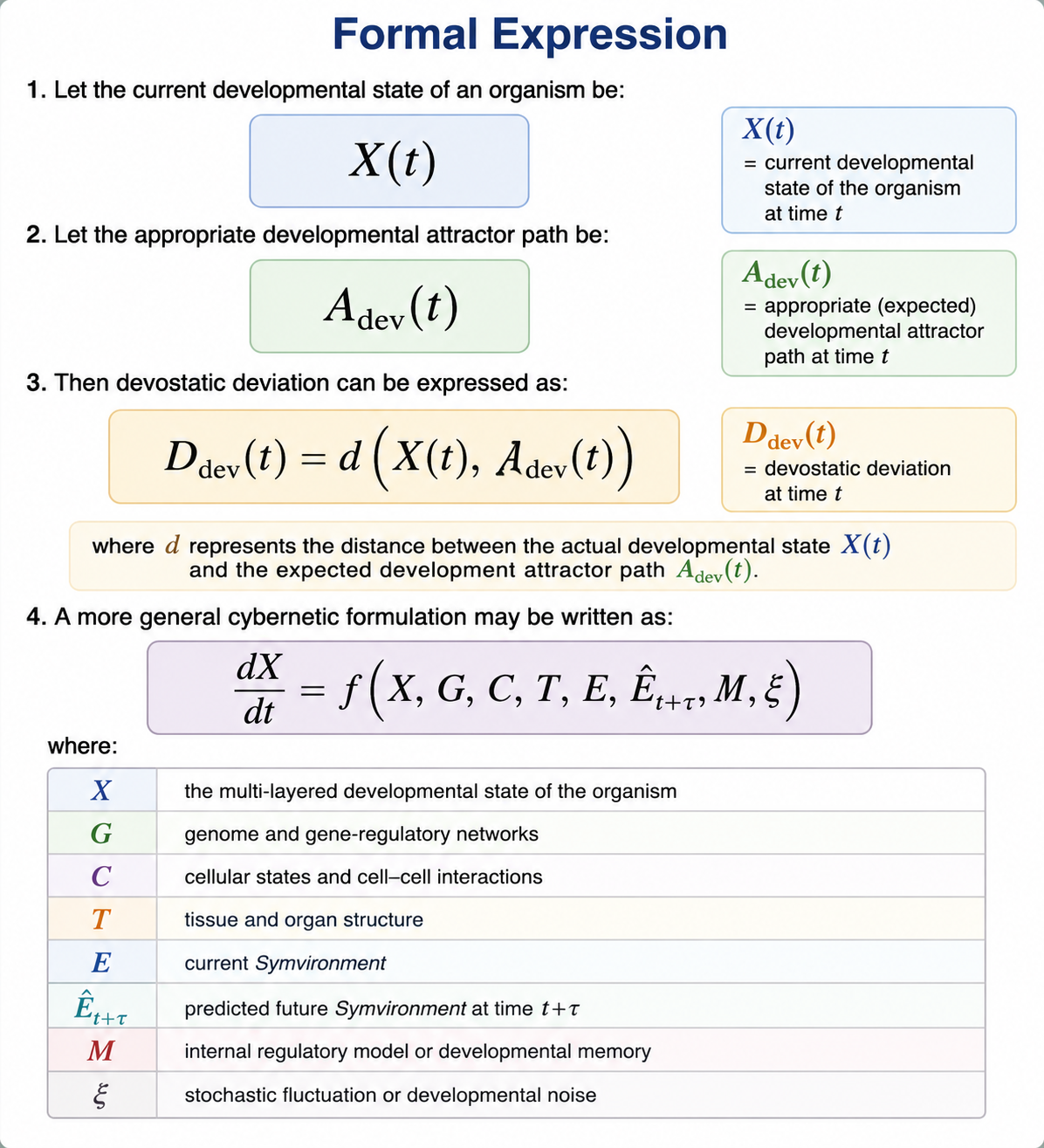
Formal Expression
Covolutionary Interpretation
From the perspective of covolution theory, devostasis is not produced by genes alone. Development is not a linear execution of a genetic program. It is a multi-layered covolutionary process in which gene, development, organism, behavior, population, and Symvironment jointly construct the developmental path.
In this framework:
Devostasis is the trajectory-stability by which a developing horon preserves its distinguishability while predictively computing and reorganizing its internal states in relation to future-relevant Symvironmental states.
Here, “stasis” does not mean stillness. It means preservation of trajectory coherence.
Critical Clarification
The main danger in the concept of devostasis is the assumption that there is a single “normal developmental path.” In reality, development does not follow one universal trajectory. There are multiple viable developmental attractor paths, shaped by genotype, maternal condition, nutrition, microbiome, tissue mechanics, social environment, stochasticity, and Symvironmental context.
Therefore, for devostasis to become a scientifically useful concept, several distinctions are necessary.
First, the relevant attractor path must be defined. It may refer to gene-expression trajectories, cell-differentiation trajectories, morphogenetic trajectories, metabolic trajectories, immune-developmental trajectories, neurodevelopmental trajectories, or organism-level functional trajectories.
Second, normality and optimality must be separated. A common developmental path is not necessarily an optimal path.
Third, devostatic failure must have measurable indicators. These may include developmental delay, cell-fate instability, tissue-boundary failure, premature senescence, inflammatory imprinting, abnormal morphogenesis, or pre-malignant attractor drift.
Fourth, devostasis must be clearly distinguished from gerostasis. Devostasis concerns the stable tracking of developmental change. Gerostasis concerns the long-term maintenance, repair, and reorganization of functional stability after maturation and during aging.
Final Formulation
Devostasis is the capacity of a developing organism to change stably along a time-dependent cybernetic attractor path. It is not the maintenance of a fixed state, but the preservation of developmental trajectory-coherence. A developing organism must constantly change, but this change must remain within viable attractor basins generated by gene-regulatory networks, cellular interactions, tissue structures, organismal regulation, behavior, and Symvironmental feedback. Devostasis is therefore the dynamic stability of development. If gerostasis describes the organism’s capacity to resist age-related functional collapse across the life course, devostasis describes the developmental basis upon which that later gerostatic capacity is built.
Devostasis is not homeostasis during development. It is trajectory-stability during development.
댓글 0